

A Scottish stone revival? Considering a comeback for Scottish stone production
Conservation, Materials | Written by: Madeleine Clark | Thursday 20 August 2026
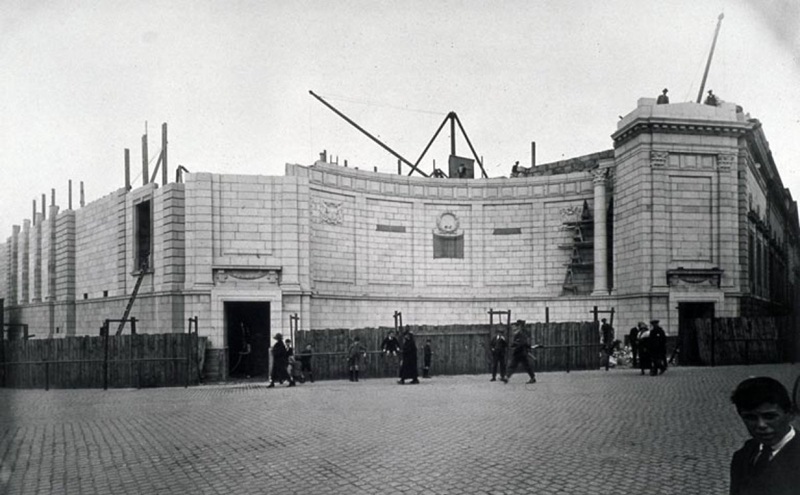
Cowdray Hall and War Memorial, Aberdeen, built with Kemnay granite. Licensed by Aberdeen City Council Art Galleries and Museums (Records of the Scottish Cultural Resources Access Network (SCRAN), Edinburgh, Scotland).
Scottish stone was once used in high-status buildings all over the world, including the Vatican. Today, lost quarries scatter the landscape. Reopening them could bring benefits to Scotland’s buildings and people. Our Technical Officer, Madeleine Clark, explores.
Scotland is a country with a diverse range of building stones due to its unique geological makeup. Colourful bands of granite, slate, sandstone, limestone and whinstone in greys, reds, yellows, browns and greens wind their way through the ground under our feet and burst out in spectacular formations. We can see this in the history of our traditional buildings.
Before the rise of canals and railways made it easier to transport stone around the country, building materials were extracted from ‘hyper local’ quarries (quarries within a very narrow area around the building site). Scottish architecture in different areas responded to what the natural environment provided. Think of the grey granite city of Aberdeen compared to the blonde and red sandstones of Glasgow, for example.
In this blog, I have drawn from Re-establishing Supplies of Scottish Stone for Building Conservation: a Global Problem with Local Solutions by Imogen Shaw, Graham Briggs and P A Everett, as well as original research on the Development Potential for Building Stone Resources in Scotland published by the British Geological Survey (BGS) and commissioned by Historic Environment Scotland (HES).

View over Trongate, from Views and Notices of Glasgow in Former Times by William Simpson, 1871. Licensed by Culture and Sport Glasgow (Records of the Scottish Cultural Resources Access Network (SCRAN), Edinburgh, Scotland).
Why is Scottish stone important?
Scotland was historically a large exporter of high-quality stones, with vast quantities shipped around the world throughout the Industrial Revolution and up to the early 20th century, including to high-status sites such as the Vatican and Cologne Cathedral. However, since then there has been a dramatic decline in Scottish building stone production, and only 17 quarries produce building stone today.
The British Geological Survey (BGS) currently recognises 198 building stone types used in Scotland in the Building Stones Database for Scotland, so this discrepancy can lead to problems when trying to match stones for repairs to our traditional buildings. Matching stone is important, not just aesthetically but also in terms of material characteristics such as porosity and permeability. Using stones that are not sympathetically matched to the original material can result in accelerated decay. For more on stone-matching, read our blog: The fascinating science of stone-matching.
Reopening Scotland’s lost quarries has the potential to not only help keep our built heritage in good condition but could also create jobs and develop traditional skills in rural areas where employment opportunities can be scarce. Retaining working age people within a community may help to increase rural populations and support local public services, such as schools and transport infrastructure. Local quarrying of stone can also help with carbon saving, as stone is inherently a low-carbon material.
Much of the embodied carbon of natural stone is from the transportation of material, so looking at sources of stone from within Scotland would reduce this impact greatly.
Isle of Luing, leading the way
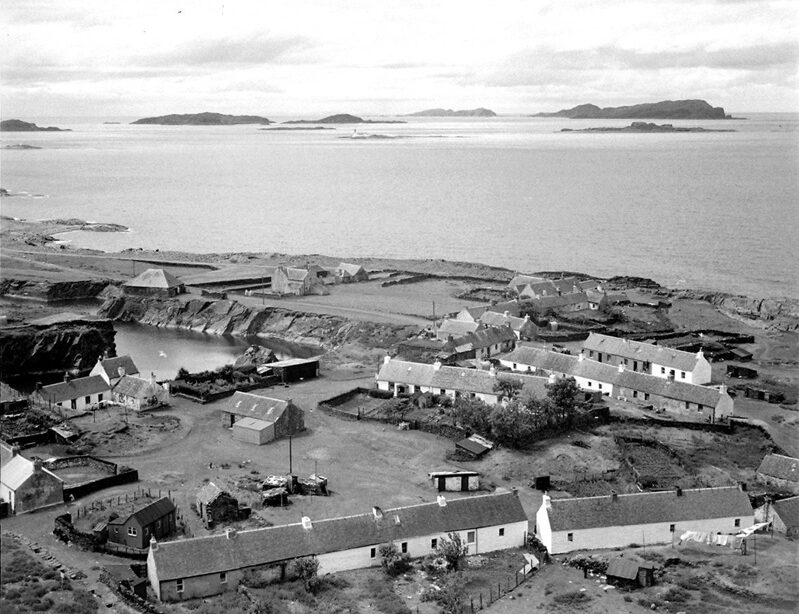
Cullipool on the Isle of Luing, Argyll, c1950, with a flooded quarry to the left of the picture. Licensed by Scottish Life Archive (Records of the Scottish Cultural Resources Access Network (SCRAN), Edinburgh, Scotland).
Exciting work is currently taking place on the Isle of Luing, which shows the possible benefits from this type of revival. The Isle of Luing is one of ‘The Slate Islands’, which exported millions of roofing slates around the world. However, all production stopped on Luing in 1965.
The Isle of Luing Community Trust, supported by Historic Environment Scotland, Highlands and Islands Enterprise, Argyll and Bute Council and the Scottish Government, is reopening one of the original quarries to start the production of roofing slate again. This will provide jobs to help support rejuvenation of the island, while providing a valuable building material. As quarrying gets underway, the slate beach, which was disappearing through coastal erosion, can also be added to periodically (as was done historically) to maintain the coastline and protect the village.
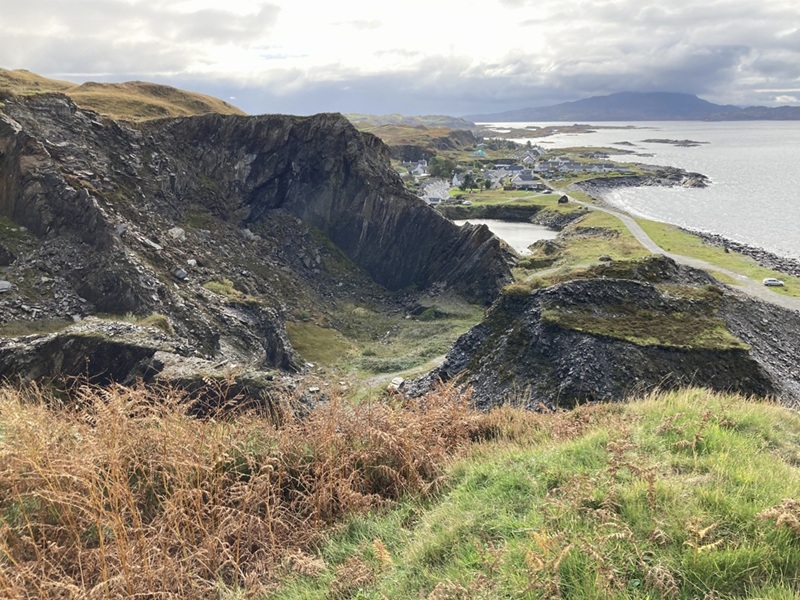
Cullipool and the flooded quarry in 2021. © Graham Briggs
The feasibility studies
A research study undertaken by BGS in 2024 looked at the feasibility and desirability of reopening a number of additional quarry sites in Scotland. To establish which quarries might be best suited to expansion or re-use, this study first evaluated the historic significance of building stones, based on the scale of quarrying of the stone historically and the reach of the stone (for example, whether it was exported internationally or nationally as well as locally).
The quarry records for the most historically significant stones in the Building Stone Database were then judged against three key criteria:
- Resource accessibility. Has the quarry been infilled or flooded? Is it already actively producing stone product?
- Setting. Is the quarry site in a coastal area? Has it been built up? Is it in use as farmland?
- Land designations. Is there any environmental or cultural protection in the area, like listed buildings, a conservation area or a Site of Special Scientific Interest?
Using this data, it was then possible to identify the quarries that would be best suited for development. From this, 170 quarries were identified as having the most potential.
The researchers were also careful to look at any potential local competition, but for most stone types there is no current production. Where there are existing quarries currently producing material such as crushed rock aggregate, this would not compete with the market for building stone extraction. However, this study demonstrated that there is potential for some of these quarries to expand into the building stone market, with the appropriate support and approvals.
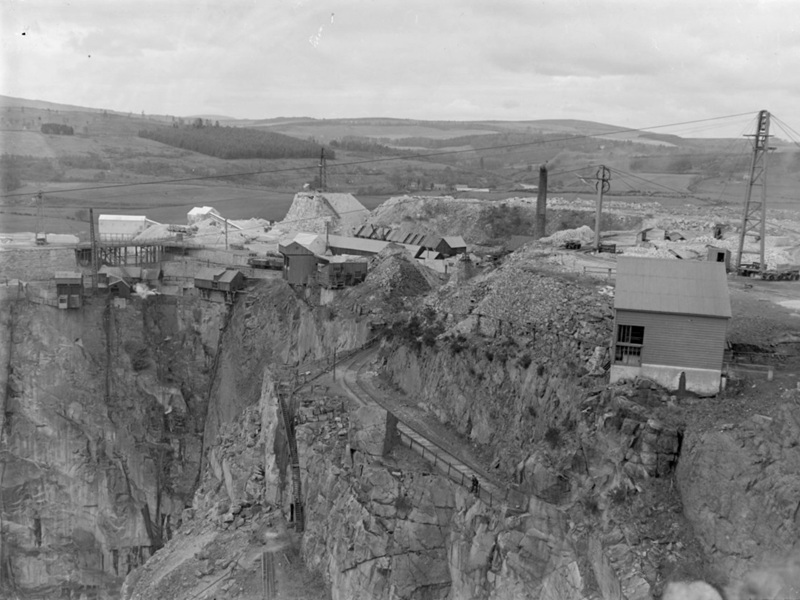
Kemnay Quarry, Aberdeenshire. Licensed by British Geological Survey/NERC. Licensed by Scottish Life Archive (Records of the Scottish Cultural Resources Access Network (SCRAN), Edinburgh, Scotland).
One site identified in the research as having ‘development potential’ is Kemnay Quarry, which is now flooded but has areas that are still accessible. Kemnay granite was used for a range of high-profile buildings, including Cowdray Hall and War Memorial. Granite continues to be quarried in this area, but currently it is only for use as aggregate. Renewed production could provide quality dimensional stone for use in both repairs to traditional buildings, as well as new builds.
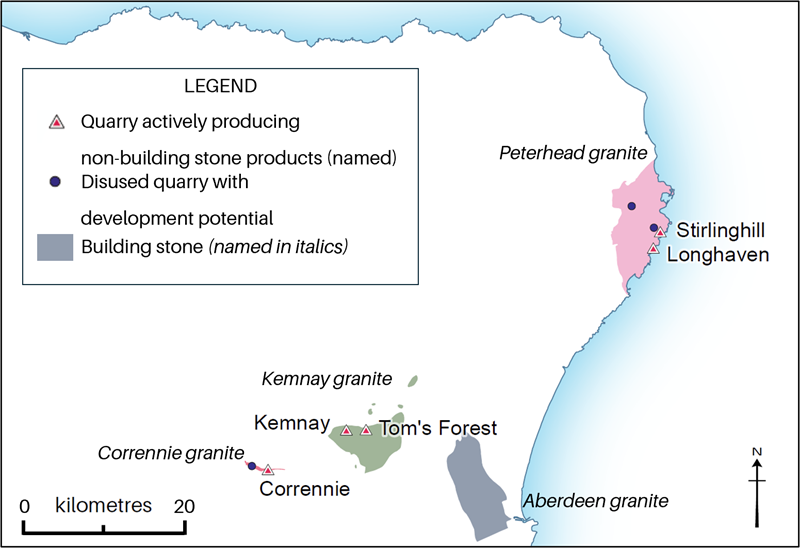
Locations of five quarries actively producing non-building stone granite products. There are also three disused granite quarries with development potential in this area of north-east Scotland. Reproduced from Shaw et al. (2025) Re-establishing supplies of Scottish stone for building conservation: a global problem with local solutions under the CC BY 4.0 licence, British Geological Survey © UKRI 2025.
The business case
To demonstrate that there would be a viable business case for an increase in stone production in Scotland, the current UK market was also investigated (statistics are only currently available for the UK as a whole). According to data from 2022, 88% of building stone used in the UK was imported, and the quantity and cost of these imports is growing year on year. Because of the rising prices of imported stone, should this trend continue, it would be possible for indigenous stone to compete well with imported material on price.
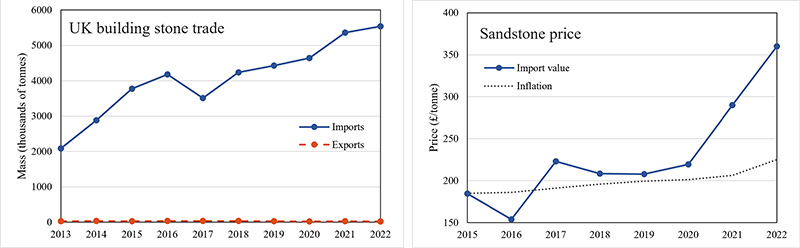
The graph on the left shows an increase in importation of building stone in the UK between 2013 and 2022 while export numbers remain at zero. This is illustrated alongside data in the graph on the right that shows a steep increase in the average price of imported building stones. The graphs cover the period 2015–2022. Reproduced from Shaw et al. (2025) Re-establishing supplies of Scottish stone for building conservation: a global problem with local solutions under the CC BY 4.0 licence, British Geological Survey © UKRI 2025.
When broader economic, social, and environmental benefits are considered, the case for local supply is compelling. These benefits include increased local employment opportunities, reduced carbon emissions, enhanced monitoring of ethical working conditions, and the delivery of community wealth building objectives. By supporting local businesses, retaining wealth within communities, and creating sustainable jobs, local sourcing can generate long-term value.
If you are working on a project using granite or sandstone, you can use our stone carbon calculator to find out the approximate upfront embodied carbon footprint per tonne. Contact us on technicalresearch@hes.scot to receive a copy.
Further reading
About the author:

Madeleine Clark
Madeleine Clark is a Technical Officer in the Technical Conservation Team. Her main focus is providing technical advice, particularly on Retrofit, but she also has a keen interest in traditional materials and skills.
View all posts by Madeleine Clark