

Can drones and AI transform how we inspect Scotland’s roofs?
Conservation, Digital, Maintenance | Written by: Guest | Friday 16 October 2026
Scotland’s traditional buildings now face increasing pressure from ageing materials, severe weather, water ingress, and the shortage of specialist conservation skills. To address these pressures, could digital technologies offer a new way forward to make roofing inspections less costly and time-consuming? Could smarter ways of working enable monitoring through interconnected technologies?
The CyberBuild Lab at the University of Edinburgh has explored how Industry 4.0 technologies, including drones and artificial intelligence (AI), could address the limitations in roof inspection practices, with a focus on slated roofs. This project was a collaboration with Historic Environment Scotland, with support from the Stirling City Heritage Trust and the National Federation of Roofing Contractors Scotland.
What is Industry 4.0?
Industry 4.0 is where digital technologies are increasingly integrated into physical environments, infrastructure and operational processes. It centres on connectivity, real-time data, intelligent systems and digitally enabled decision-making. Emerging technologies associated with Industry 4.0 include AI, the Internet of Things (IoT), cloud computing, digital twins, robotics, automation systems, augmented reality, advanced sensors and unmanned aerial vehicles (UAVs) more commonly known as drones.
Together, these technologies can capture and interpret large volumes of data quickly and accurately. Within the built environment sector, Industry 4.0 technologies are increasingly being used to improve asset management, predictive maintenance, safety, operational efficiency and long-term sustainability.
Inspecting Scotland’s roofing
Traditional buildings, like all buildings, rely on their roofs for protection from the elements. In the context of slate roofs, when slates become damaged, are displaced or fall, the consequences can be significant. Water ingress can damage historic features, increase repair costs and, if left unchecked, lead to more serious structural problems and potential irrecoverable loss altogether.
As a result, there is growing interest in better ways to inspect and monitor the condition of historic roofs. One technology attracting attention across the sector is the use of drones. By capturing detailed photographs and images from areas that are often difficult to access safely, drones can help identify damaged slates, blocked gutters and other maintenance issues without the need for extensive scaffolding or access equipment.
Challenges of current roof inspection methods
Inspecting slate roofs at heritage sites normally requires surveyors and roofing specialists to gain direct access to the roof and access individual slates. This can be time-consuming, costly and, in some cases, involve working in challenging conditions. Additionally, interpreting and recording defects still relies largely on individual judgement and paper-based reporting.
To address such challenges, more consistent approaches to inspection and record keeping are being considered, helping owners and conservation professionals track changes over time and make better-informed decisions about repair and maintenance.
What steps have been taken towards Industry 4.0 for Roof Condition Monitoring?
The CyberBuild Lab project team has developed a method based on what is known as a digital twin, a virtual version of a real roof that can be updated as new inspection data becomes available (Figure 1). Images captured by drones and AI are jointly used to record the location and severity of defects, and ultimately the overall condition of roofs, creating a detailed record of the roof over time.
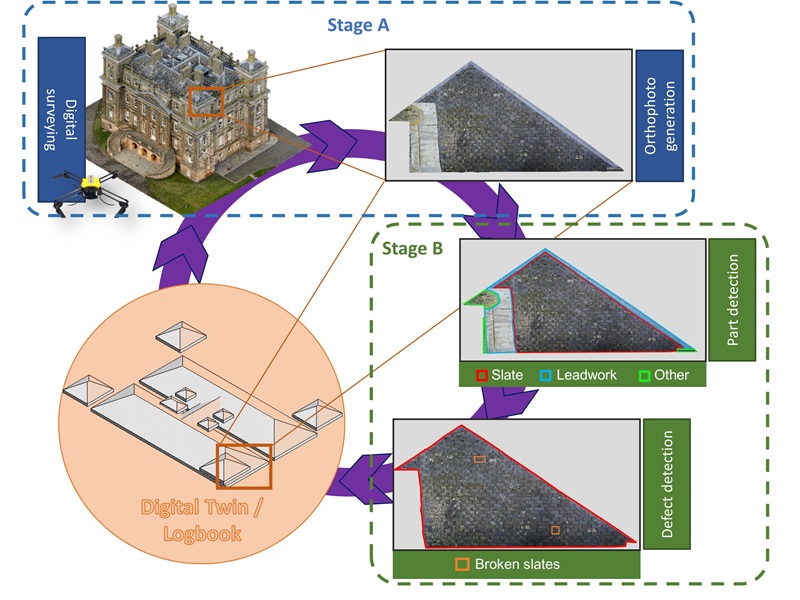
Figure 1 shows how the proposed approach works. First, detailed images of the roof are captured using a drone. These images are then processed using artificial intelligence (AI), which can distinguish between different roof materials and help identify visible flaws within the slate covering.
The information is used to create a digital model of the roof, creating a structured record of its condition. As further surveys are conducted, new information can be added and compared with previous inspections. This makes it possible to track how defects develop over time and build a clearer picture of the roof’s overall condition.
Interested in learning more? This publication on slate detection in orthophotos of building roof panels explains the image analysis techniques behind this work.
Case study: Duff House
Duff House, a historic Georgian mansion in Banff, Scotland, with a complex roofscape and architectural detailing, provided an ideal test case for the proposed approach.
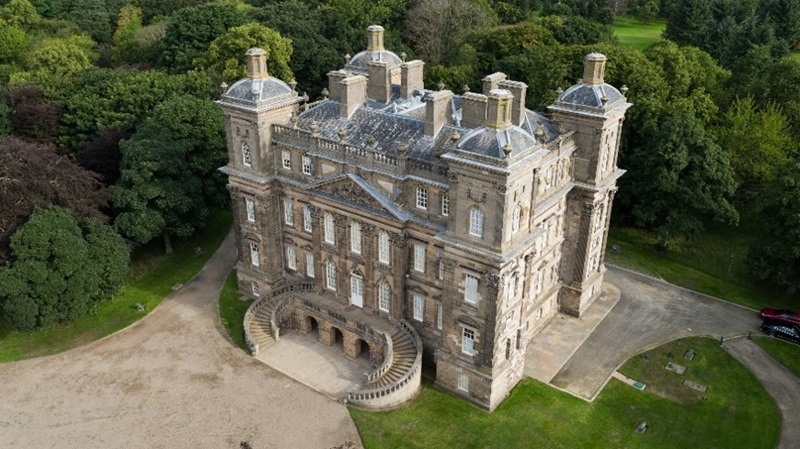
Figure 2b. Aerial shot capturing the roof of Duff House
Aerial photograph of a large historic castle with four prominent corner towers and a central courtyard. The castle is surrounded by green lawns and curved driveways, with trees visible on the left side and parked cars on the right.
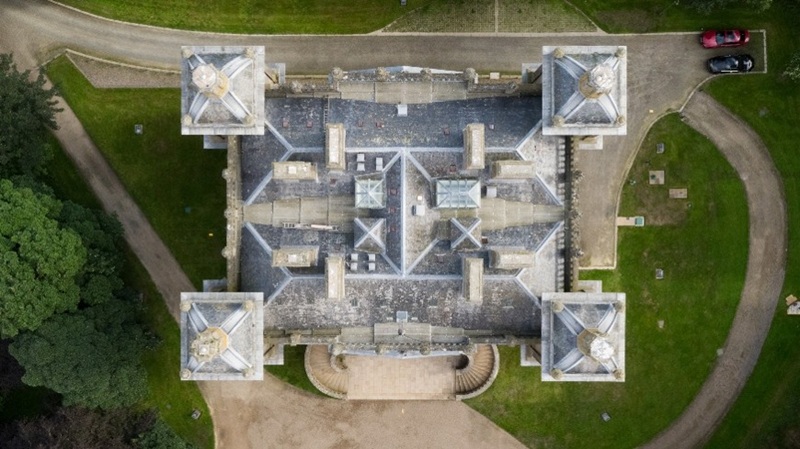
Figure 2b. Aerial shot capturing the roof of Duff House
Using images captured by drone, the project team created an accurate digital representation of the roof and generated detailed images for each roof panel (Figure 3). In this case, the condition of a roof composed of 36 panels with a total area of 615m2 is obtained after automatically processing the data acquired by a drone survey conducted in less than 2 hours.
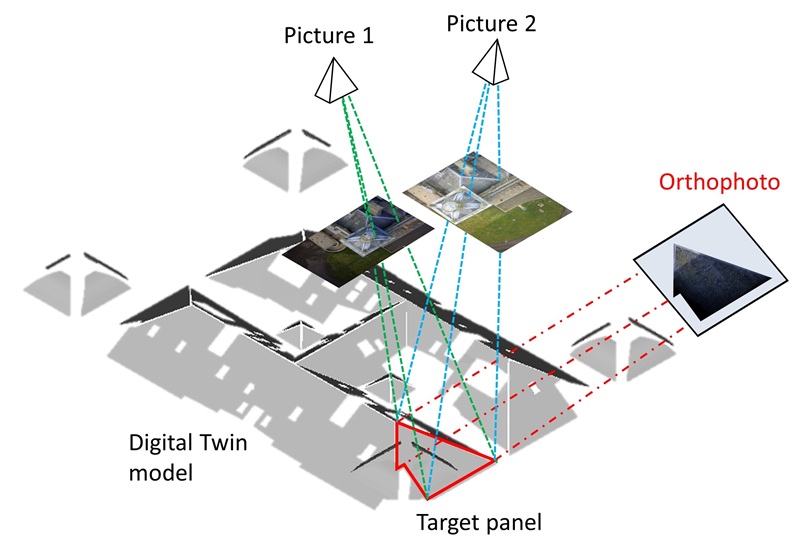
Figure 3. Stage A – Orthophoto generation process for one of the Duff House roof panels.
AI Model Analysis
More specifically, with the roof models created, AI is used to distinguish between different roof materials, including slate and leadwork (Figure 4). The system can then begin to identify areas where defects may be present, helping to focus attention on parts of the roof that may require closer inspection.
To help validate the approach across different building types, additional trials were also carried out on a traditional semi-detached house and a historic church in Stirling.
The early results are encouraging and demonstrate the potential for AI to support roof condition surveys. However, the technology still requires further improvements to achieve high levels of performance and robustness.
For this reason, AI should currently be viewed as a tool to assist conservation professionals rather than replace them in conducting visual condition assessment.
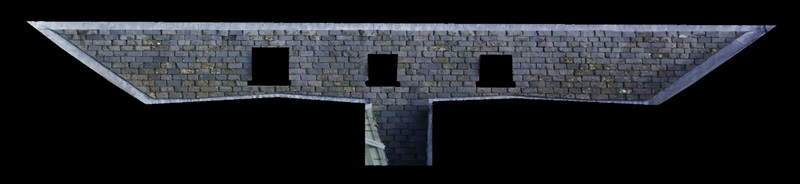
(a) Orthophoto of a roof panel obtained after Stage A.
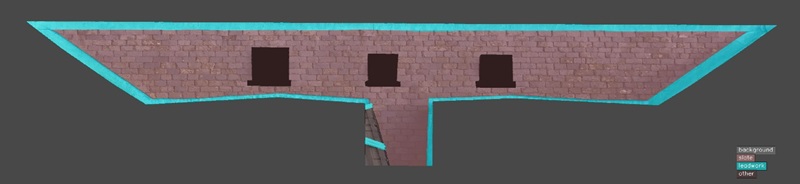
(b) Identification of the slated area of in the roof panel orthophoto. Legend: Gray=Background, Red=Slates, Blue= Leadwork, Brown=Other.

(c) Defective slate detection: biological growth (top) and structural defect (bottom)

Figure 4: Stage B – Orthophoto processing for one of the Duff House roof panels
What can roof contractors and traditional building owners take away from this?
Two important themes emerge from this work: the value of good building records and the future potential of AI.
Information Management
Traditional buildings often have long and complex histories, yet information about previous faults and maintenance work can be difficult to obtain or may be held in different places. A digital record that brings this information together could help relevant stakeholders better understand how a building has changed over time and make more informed decisions about its future care. Such a comprehensive digital record is increasingly referred to as a “Digital Building Logbook”. The approach described in this study contributes to that goal by creating a consistent record of roof condition and identified defects.
AI-Driven defect detection
The use of AI presents exciting possibilities, but there are still challenges to overcome. While technology is showing promise in helping to identify roof defects, it is not yet accurate enough to be relied upon without human oversight, especially for traditional roofs. One of the biggest challenges is the limited amount of suitable data available to train these systems.
As more information becomes available and the technology continues to improve, AI is likely to become an increasingly useful tool for supporting roof inspections and condition monitoring. Besides, analysis will increasingly consider other than just visual data, in particular thermal image data. For now, however, it is best viewed as a way of assisting professional judgement rather than replacing it for visual assessment.
Looking Ahead
The adoption of drone technology for roof inspection represents the next step in a much broader digital transformation within the heritage sector. If you are interested in how these technologies have been developing over time, our publication on Applied Digital Documentation in the Historic Environment examines how digital tools support the management of historic assets, and digital documentation, computer vision and machine learning for masonry surveying and maintenance explores how emerging technologies are supporting the inspection and care of traditional masonry.
While fully automated roof condition analysis and repair decision-making are still developing, progress in the field is advancing rapidly. The combination of drones, high-resolution imaging, AI-assisted analysis and digital monitoring tools is beginning to reshape how we understand, maintain and protect historic buildings.
For conservation and heritage professionals, this creates an important opportunity. Those who remain informed and open to emerging technologies are likely to be better positioned to respond to future maintenance challenges, reduce long-term costs and improve the resilience of historic structures. Solutions that once felt experimental are steadily moving closer to becoming practical, accessible tools for day-to-day conservation and building management work.
As these technologies continue to evolve, an important question remains: could routine drone-based roof monitoring eventually become a standard part of managing and safeguarding historic buildings? And how should the heritage sector balance technological innovation with traditional conservation principles and practices?
Interested in how the heritage sector might use AI and what concerns and opportunities there are? Take a look at our AI Futures in the Heritage Sector report.
About the authors
- Dr Jiajun Li, CyberBuild Lab, University of Edinburgh
- Dr Lyn Wilson, Cultural Assets Directorate, Historic Environment Scotland (HES)
- Dr Frédéric Bosché, CyberBuild Lab, University of Edinburgh: Reader in Construction Informatics and Leader of the CyberBuild Lab. Frédéric has nearly 20 years of experience in conducting research on using novel reality capturing technologies and developing novel data processing techniques for the AEC/FM sector
About the author:
Guest
From time to time we have guest posts from partners, visitors and friends of the Engine Shed.
View all posts by Guest