

In search of Angus flagstone roofs: a rare and distinctive Scottish tradition
Conservation, Materials, Vernacular and earth building | Written by: Guest | Thursday 23 July 2026
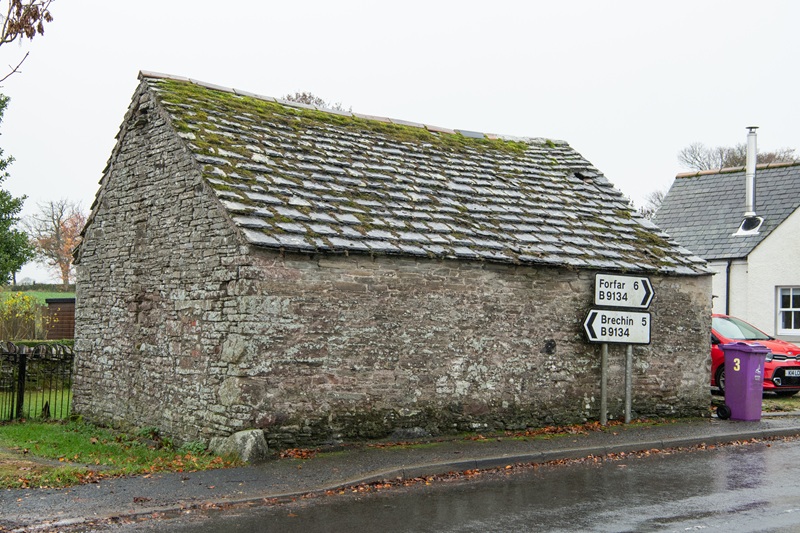
Building recorded as having flagstone roof, Angus, 2025.
Flagstone roofs are rare in the United Kingdom, found clustered in areas where there is a local source of this type of stone. But in one area on the East Coast of Scotland, Angus, flagstone has been used as a roof covering for over 500 years.
We have been carrying out some detective work to find out how many buildings are left with roofs of Angus flagstone. In this blog we explain why this vernacular (based on local needs and materials) type of roofing is important and discuss our findings.
What is Angus flagstone?
Flagstone is a term given to sedimentary rocks such as sandstone and siltstone that split naturally into thin slabs or ‘flags’.
Old Red Sandstone is a large sequence of Devonian-aged rocks found throughout Angus. Within this larger sequence is a smaller section called the Dundee Flagstone Formation. The flagstone beds were laid down by rivers circa 405 million years ago, when Scotland was situated south of the Equator, at roughly the same latitude as southern Angola is today.
They are comprised of fine sand and mud and split into hard, durable slabs of about 25mm thick – ideal for use as paving, masonry and roofing.
In the 19th century, flagstone was exported from Angus for use throughout the world and the production and export of ‘Arbroath paving’ was a major industry in Scotland. 144 quarry sites have been identified in the area, with only one, Pitairlie Quarry, operating today.
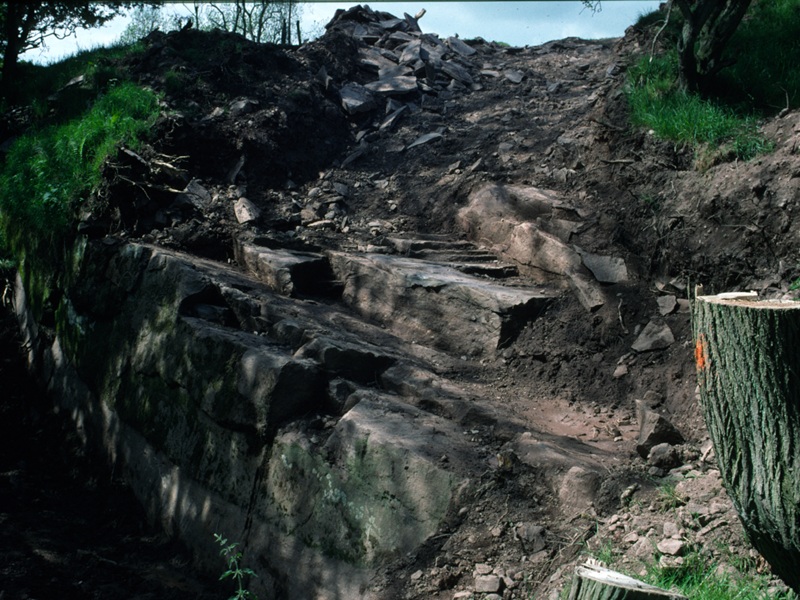
Flagstone beds in situ at the former Melgund Quarry, Angus. © Benjamin Tindall
Flagstone roofing: local and long-lasting
Flagstone roofing is found on a wide variety of building types. These range from castles, abbeys and palaces, to cottages, steadings and workshops. The material was ideal for this purpose because it was long-lasting, available locally and produced an attractive and robust roof.
Flagstone roofing slates are often referred to as ‘stone slates’, however this terminology can cause confusion so we haven’t used it in this study.
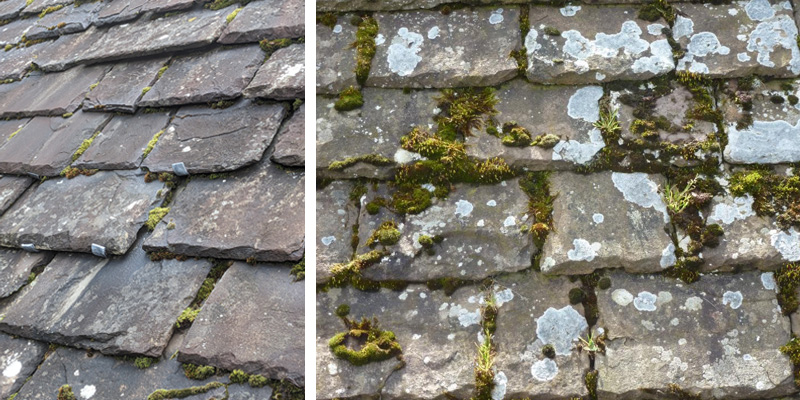
Examples of flagstone roofing: (left) Falkland Palace, Fife. © Sara Carruthers, and (right) St Athernase Church, Fife. © Douglas Binnie.
Flagstone slates are typically larger and thicker than the more commonly seen blue-grey metamorphic slates. Buildings with flagstone roofs can often be spotted from a distance by their uneven texture, brownish colour and large, pale lichens. Viewed from closer proximity, the flagstone is seen to vary in thickness, texture and colour between roofs.
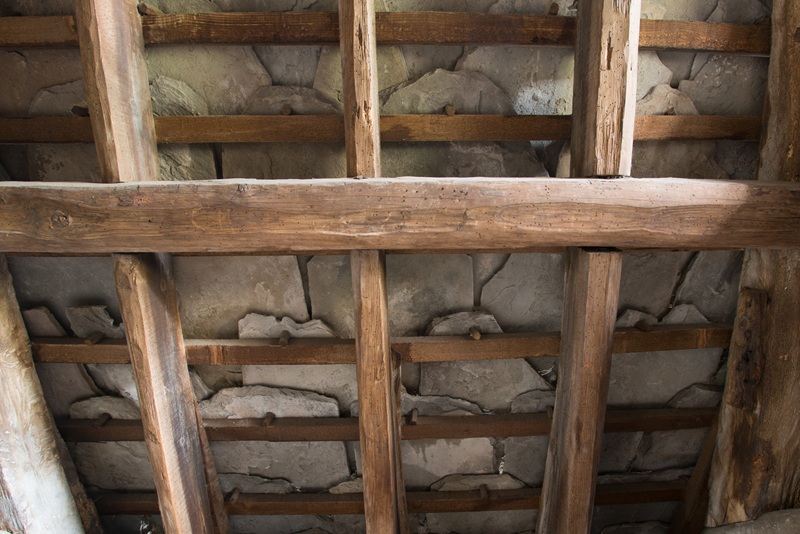
Interior view of the roof of Claypotts Castle, Dundee, showing the slates hung from the wooden battens by a single wooden peg.
On the oldest roofs, flagstone slates were hung on wooden battens, each held by a single wooden peg. There is a highly skilled art to sorting and laying flagstone slates, all of slightly different lengths, widths and thicknesses, to create an ordered, weathertight and long-lasting roof.
From small villages to city villas
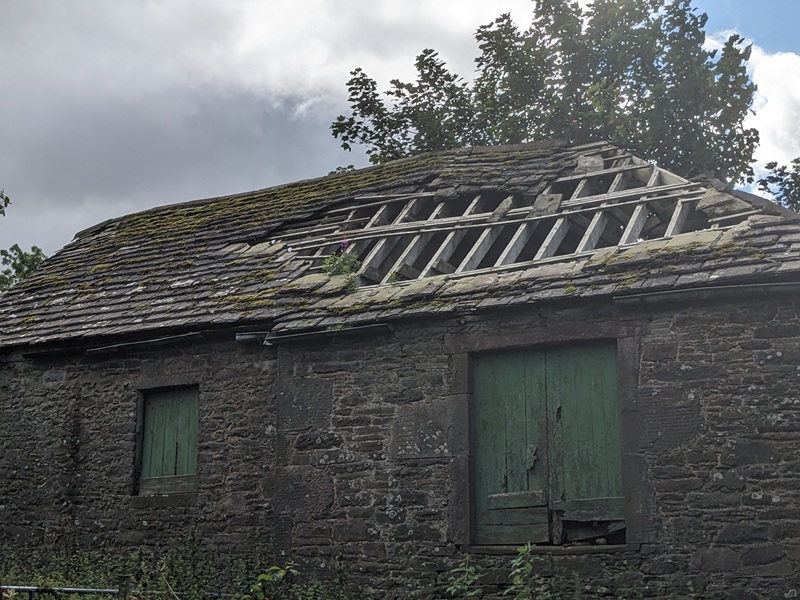
South Balluderon Mill, Angus, showing the wooden batten construction of the roof. © Sara Carruthers
Flagstone roofs used to be much more common in the towns, villages and countryside of Angus, and still contribute to a distinctive appearance and character in areas such as around Little Causeway in Forfar, and villages such as Glamis and St Vigeans. Most of the buildings with flagstone roofs have been built in the vernacular tradition. This means that they were built using local materials and in a local style, which evolved over time with the experience of the skilled craftspeople or locals who built them.
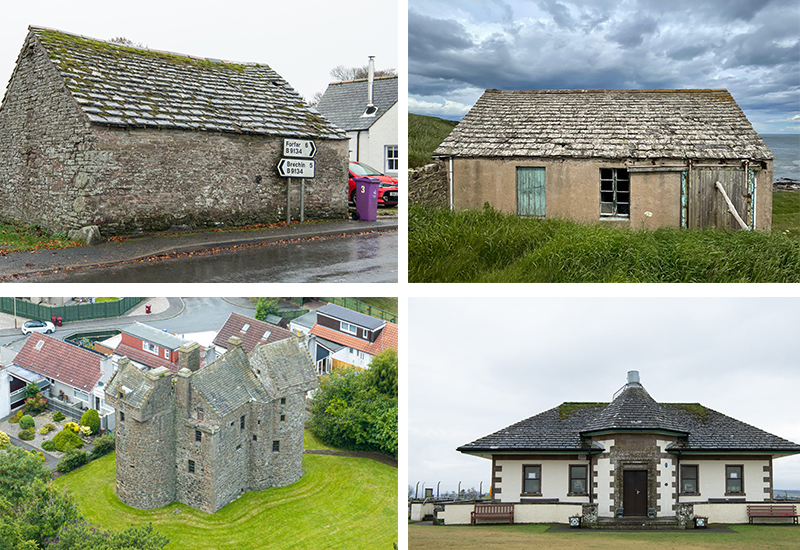
Examples of flagstone roofing. Top left: Outbuilding, Crosston, Aberlemno. Top right: Store, Boddin, © Douglas Binnie. Bottom left: Claypotts Castle, Dundee. Bottom right: Barrie Cricket Pavilion, Kirriemuir.
Angus flagstone was used in several early conservation projects in the late 19th and early 20th centuries. These include Falkland Palace in Fife, Stenhouse Mansion and Acheson House in Edinburgh, and St Fillan’s Church, Aberdour.
Around the same time, flagstone became a feature of new buildings designed in the Arts and Crafts style. These included large villas in Dundee, Edzell and St Andrews, and the Barrie Cricket Pavilion in Kirriemuir. Specific records of quarrying for these projects have not been found, but there may have been small-scale production for bespoke orders, not recorded in the same way as during peak international production.
The last Angus flagstone quarries appear to have closed by the 1950s, but the industry had been in sharp decline since the First World War.
Flagstone roofs at risk
For roughly 50 years after production ceased, the only source of flagstone roofing was the second-hand market. Slate merchants held a sufficient supply, sourced from the demolition or ‘improvement’ of unprotected buildings. Many unlisted vernacular buildings lost their flagstone roofs in this way, with the material being taken for re-roofing of grander buildings.
However, these original materials are aging, and it has become increasingly difficult to find reclaimed flagstone in a good enough condition for reuse. Roofs have therefore often been replaced with concrete tiles.
At Historic Environment Scotland, we care for a number of buildings with Angus flagstone roofs. We recognise that obtaining materials to keep them in good repair has become a problem. It is not ethically acceptable in building conservation to source materials in a way which may encourage the destruction of another historic building. Angus flagstone roofs are at considerable risk and if nothing is done to address the rate of loss there will soon only be a handful of roofs left.
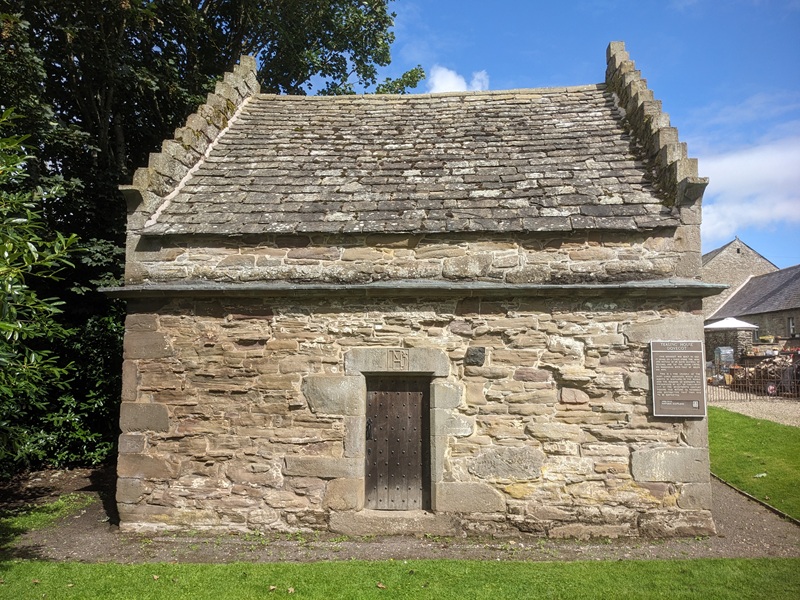
Tealing Doocot. © Sara Carruthers
Protecting these beautiful roofs for the future
In 2023, we commissioned a study to gather information on what is currently known about Angus flagstone as a building material. The study included a literature review and a survey to understand how many flagstone roofs might remain in Angus and the surrounding areas.
Sadly about 25% of the buildings in the audit appear to be unused and at least 30% of the roofs are in poor condition. Action is therefore needed to protect more of these beautiful roofs. We are working to address the difficulty in sourcing materials and engaging with partners to ensure retention of the specialist skills required to maintain this local tradition.
We are now in a fortunate position with Angus flagstone. Unlike many other building stones, a new source has become available, and we are able to secure appropriate material once more. In 2004, Pitairlie Quarry re-opened for the first time since 1915 – a hiatus of nearly 90 years.
Over 200 buildings have been found, but this is unlikely to be all of them – can you find more? If you know of others that have not been included, let us know and we will aim to add them during future updates.
Download Angus Flagstone Roofing Volumes 1 & 2.
About the author
Sara Carruthers MCIOB, BSc (Hons), MA (Conservation, IoAAS). is an independent consultant and Certified Building Conservation Specialist (Project Manager, Regulatory) with the Chartered Institute of Building, who has specialised in the conservation of historic buildings and monuments for over twenty-five years.
About the author:
Guest
From time to time we have guest posts from partners, visitors and friends of the Engine Shed.
View all posts by Guest