

The tools and techniques of traditional ship caulking
Maintenance, Materials, Skills | Written by: Rowan Duffy | Thursday 2 July 2026
The Royal Research Ship (RRS) Discovery is an icon of polar exploration, having carried Robert Falcon Scott and Ernest Shackleton on their intrepid journey to Antarctica between 1901 and 1904.
The ship is currently undergoing major restoration including extensive work on deteriorating structural timbers. Our Conservation Engineering Craft Fellow, Rowan Duffy, has been working on the project, mentored by JPS Restoration. Rowan is learning one of the oldest maritime craft techniques – caulking. Here, Rowan shares a brief history of this craft skill and talks us through the caulking process.
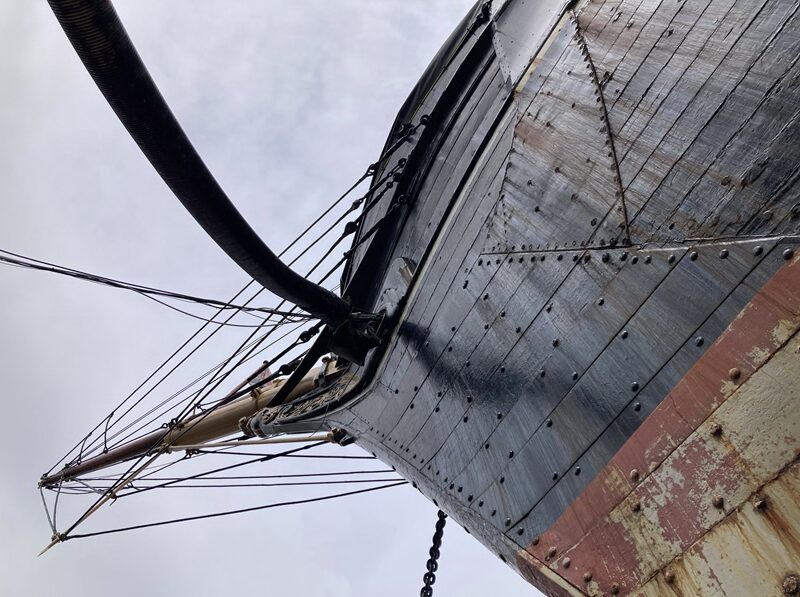
The RRS Discovery was the first vessel to be constructed specifically for scientific research, built in Dundee for the 1901 British National Antarctic Expedition.
What is caulking?
Caulking is an enduring skill in the history of boatbuilding. The hull and deck of a wooden ship are constructed from individual planks that are fitted as closely together as possible. Without something to seal the gaps between these planks, surfaces would function as a sieve rather than a strong watertight surface.
For as long as humans have been building boats, all sorts of things have been stuffed between the seams to keep water out, with historical records showing hair, moss and even animal fat used to try and seal the gaps between planks.
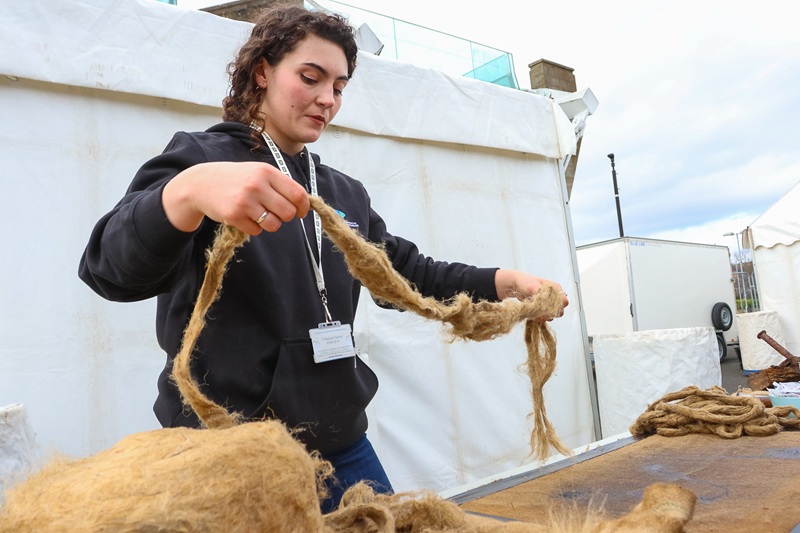
Rowan Duffy demonstrating caulking at the Engine Shed’s Traditional Skills Open Weekend in March 2026. © Scott Louden
Caulking is a centuries-old, labour-intensive, traditional shipwrighting technique, and has been in continuous use for several hundred years. It is the process of sealing gaps between wooden planking on a ship’s hull or deck to ensure waterproofing, whilst allowing the timber to flex, expand and contract as humidity levels vary. Historically, caulking was a trade in its own right.
Caulking is also used in other capacities, for example as a natural method for plugging gaps between timber-framed windows and other components of timber frames.
A brief history of oakum
Oakum is one of the oldest caulking materials in the world. It is indispensable in the maritime industry, as well as a foundational material in naval construction, particularly before the widespread adoption of iron and steel hulls.
For centuries, oakum was made from torn old rigging rope. Prisoners and workhouse inmates were made to tease out the fibres from old ropes without any tools. Known as ‘picking oakum’, this brutal form of hard labour was tedious and hard on the fingers. The picked oakum was sent to shipyards where it was sold to the navy or other shipbuilders.
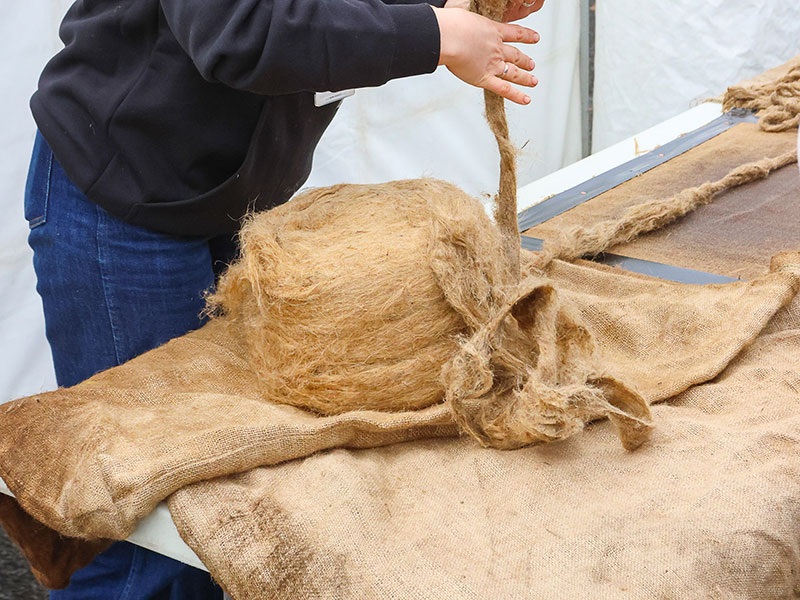
Compressed oakum before rolling. © Scott Louden
Oakum is a material made from jute fibres. It is rolled into a consistent, almost felted, form, then driven into the gaps between planks using specialist tools. It is typically saturated with linseed oil and Stockholm tar – a pine tar known for its antibacterial properties, and sometimes used for treating hoof conditions in animals. The Stockholm tar acts as a natural and durable preservative for wood, preventing rot and moisture penetration. It improves the oakum’s sealing properties, as it makes it hydrophobic, protecting the fibres from decay whilst keeping them flexible. A long-lasting seal is created that allows the deck planks to shift, expand and contract without causing leaks.
Tar has been used by mariners as a wood preservative for hundreds of years. By slow cooking resin-rich pine roots and branches in a kiln, the wood undergoes destructive distillation – producing a dark, viscous, aromatic liquid. Few people are ambivalent about its distinctive smell – smoky and intensely medicinal.
How to caulk
The process is an intricate and nuanced craft. It involves driving oakum deep into the wedge-shaped seams between planks, using specialist caulking tools. Caulking tools are designed to allow for a firm and even distribution of oakum along the seam, without damaging the wood.
Depending on the depth of the seam, after two to three layers of oakum have been driven in, a stopping compound such as pitch (tar) is poured over the fibrous layers. Traditionally, in the case of hull planking, red lead putty was applied with a palette knife, as the longevity of the putty minimised rot in faying (touching) surfaces – where wood meets wood. However, due to the toxicity of this compound some boatbuilders now use modern polyurethane mastics. On RRS Discovery, the stopping compound used on the main portion of the deck repairs is ‘Jeffrey’s Marine Glue’, a traditional product which requires a cauldron to melt it down before use.
Starting the caulking process
The caulking process begins by raking out the seams using a reefing hook. This is an angular tool which loosens old, brittle pitch and oakum. Great care must be taken to prevent splintering the wood. It is common for reefing hooks to be fabricated specifically to suit the seam depth and width.
Preparing the oakum for use
On RRS Discovery, the oakum used is processed at Verdant Works museum in Dundee, where it goes through a softening machine. This machine processes the hard fibres into a pliable material, using oil and water to lessen its rigidity. It is coiled into a barrel-like form which then requires separation into distinct strands. After it has been separated, it is rolled on a hessian mat coated in Stockholm tar. Hessian is used as the rolling surface as it offers a good grip, speeding up the process.
A good deal of judgement is required to caulk a seam. How much oakum is driven in depends on the shape and width of the gap. To fit narrower seams the shipwright may need to roll the oakum into thinner strands on their knee.
Inserting the oakum
A variety of hand-forged steel irons are used during the caulking process. Caulking irons look a little bit like fishtails, which seems appropriate!
A ‘making iron’ is used to tuck the rolled oakum into the seam in small loops, and again to pivot these loops further down into the seam. After this, the oakum must incur another drive down to ensure that the material is firmly set into the seam. This is done using a ‘hardening iron’.
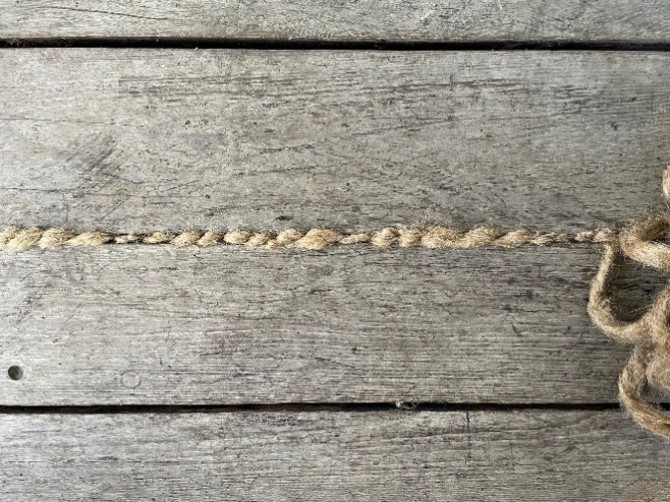
Deck seam showing first layer of oakum looped in before drive in with hardening iron © Rowan Duffy.
Hardening irons have different gauges from thin to thick and are selected to suit the width of the seam you are working on. They are typically hit harder than the making irons and have a characteristic groove along the bottom edge of the blade. This compresses the material to sit nicely within the bevel of the plank, allowing the shipwright to finish off the seam before tar is poured.
Other tools used include ‘bent irons’. These are for awkward areas that the straight irons cannot reach, such as where the keel meets the hull. They provide more clearance for mallet swings whilst ensuring the iron hits the oakum into the seam at the correct angle.
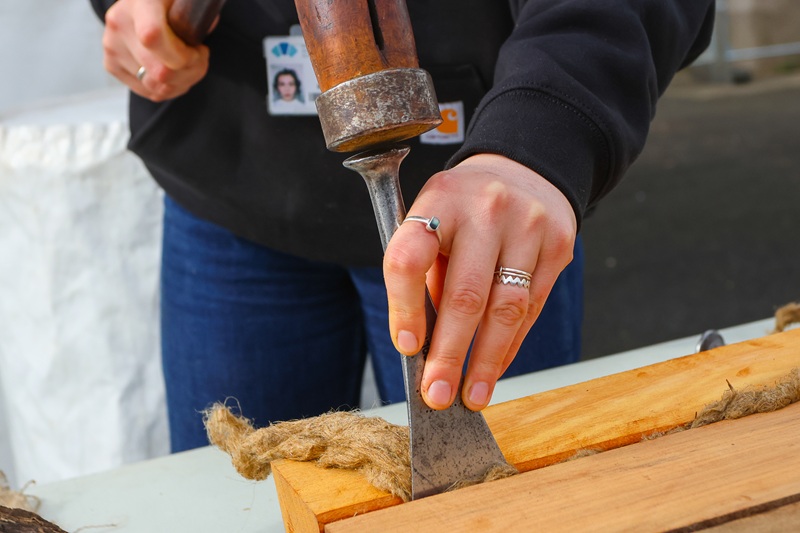
Caulking mallet strikes a making iron during demonstration at the Traditional Skills Open Weekend, the Engine Shed. © Scott Louden
The caulking mallet is a distinctive looking tool, with an elongated handle and heavy slotted head. The tool is designed specifically in this way to reduce shock and vibration when striking the caulking iron. As well as increasing efficiency, the design allows the user to tune the striking sound as to whether the iron is penetrating too little or too deeply into the seam. It resonates loudly upon a strike, with a distinctive chirp-like sound ringing out. Without the slots the noise made by a gang of shipwrights would be deafening! Metal rings on the head of the mallet provide support to prevent the wood mushrooming from the repeated impact upon the caulking irons.
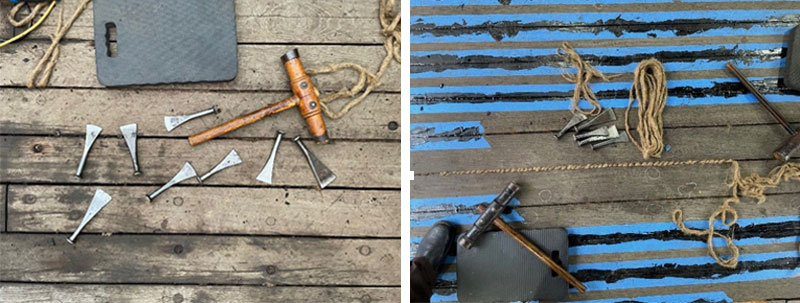
Left: A variety of caulking irons and a caulking mallet laying on deck seams which have been ‘raked out’. Right: Caulking setup showing a variety of stages. The central area is being caulked while seams with blue tape have been caulked, ‘payed’ with pitch, and are awaiting ‘spooning’ or ‘tooling’ before the tape is lifted. © Rowan Duffy.
Applying pitch (tar)
After the oakum is driven tight, it is protected from water by a layer of melted pitch. To comply with current safety regulations and insurance requirements, an electrically controlled compound heater is used to melt the pitch. The pitch is then poured over the caulked seams at a working temperature of 190℃. Adhering to the seam for many years, the pitch remains flexible in low temperatures whilst withstanding softening at high temperatures. After the pitch is poured, a flexible putty knife is used to push the tar further into the seam, a process referred to as ‘spooning’ or ‘tooling’. This ensures that the pitch locks in the oakum, providing a waterproof barrier. Finally, excess pitch is scraped off ensuring it lies flush with the deck.
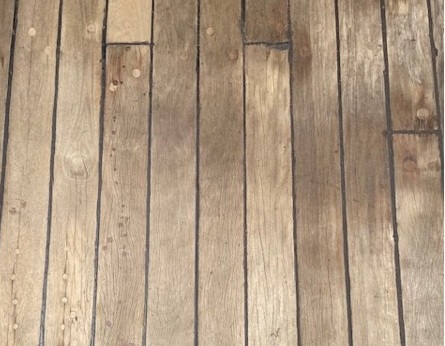
Completed portion of the main deck on RRS Discovery © Rowan Duffy
Find out more
By preserving caulking and teaching the process to others, we can reconnect with our impressive maritime legacy, and ensure the survival of renowned historic ships including the RRS Discovery.
Read more about the conservation of the RRS Discovery.
Discover our craft fellowships, keeping traditional skills alive.
Learn more about training craftspeople.
About the author:
Rowan Duffy
Rowan Duffy is our Conservation Engineering Craft Fellow, a role which involves working on large object conservation projects including historic ships, ornamental cast iron structures, clocks, fountains and steam engines. Rowan has a background in the arts, working in museums and galleries after graduating with a degree in History of Art. Rowan became a Craft Fellow after deciding to pivot her career towards a more practical role.
View all posts by Rowan Duffy