

How climate change is impacting Scotland’s stone memorials
Climate Change, Conservation | Written by: Guest | Friday 27 November 2026
Climate change is a current and real threat to Scotland’s heritage. It is increasingly affecting historic memorials. Drawing on her experience in memorial inspection and surveying, Emma Frost explains what these impacts are, the signs to look out for and what can be done to manage risk.
Memorial safety is often overlooked when we talk about heritage conservation, but cemeteries and graveyards are important public spaces. There have unfortunately been several fatal accidents within UK cemeteries, which may have been avoided if more robust survey checks were in use. Memorial safety inspections are now mandatory by law in Scotland, under the Burial (Management) (Scotland) Regulations 2025, and regular inspections are a priority for public bodies and private owners responsible for maintaining cemeteries.
We use ‘cemetery’ throughout this blog to mean all burial grounds.
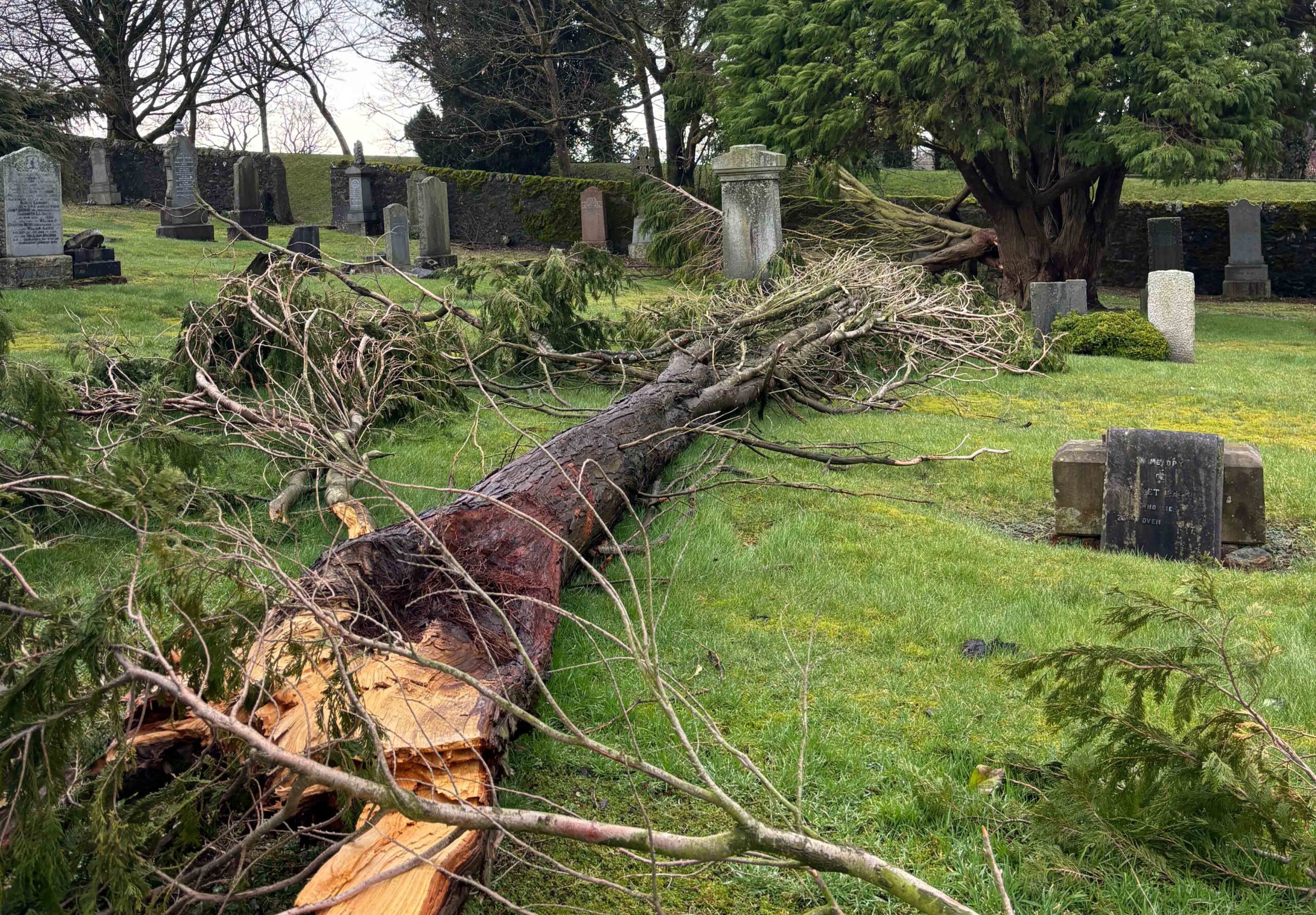
Aftermath of storm Eowyn, Paisley, January 2025.
How does climate change affect memorials?
While memorials have always been subject to natural weathering and biological growth, climate change is an increasing threat, speeding up the natural processes of decay through:
- escalating storm intensity
- increased rainfall
- greater temperature fluctuations
- accelerated vegetation growth
Memorials often stand exposed in unsheltered, outdoor environments, leaving them particularly vulnerable. The urgency of conservation grows as climate pressures mount, requiring both routine care and timely intervention.
Climate change also influences the long-term chemical and physical processes that wear down stone.
Increased humidity and pollutants in the atmosphere accelerate acid rain, which is particularly harmful to carbonate-based stones such as marble and limestone. Over time, surfaces begin to “sugar”, crumbling into a powdery texture that erodes carved details.
The wetting and drying cycle is intensifying year by year, and this repeated process is particularly damaging to more porous stone. Centuries-old memorials are showing a marked acceleration in damage.
Temperature fluctuations also take their toll. Water that seeps into joints, cracks and pores freezes in colder conditions, expanding and widening the gaps. This freeze-thaw cycle is becoming more frequent in regions previously less prone to such extremes. Increasingly, we are dealing with harsher weather from the east. This means that east coast cemeteries, previously almost untouched by severe weather, are now experiencing intense wet weather more typical of the west of Scotland.
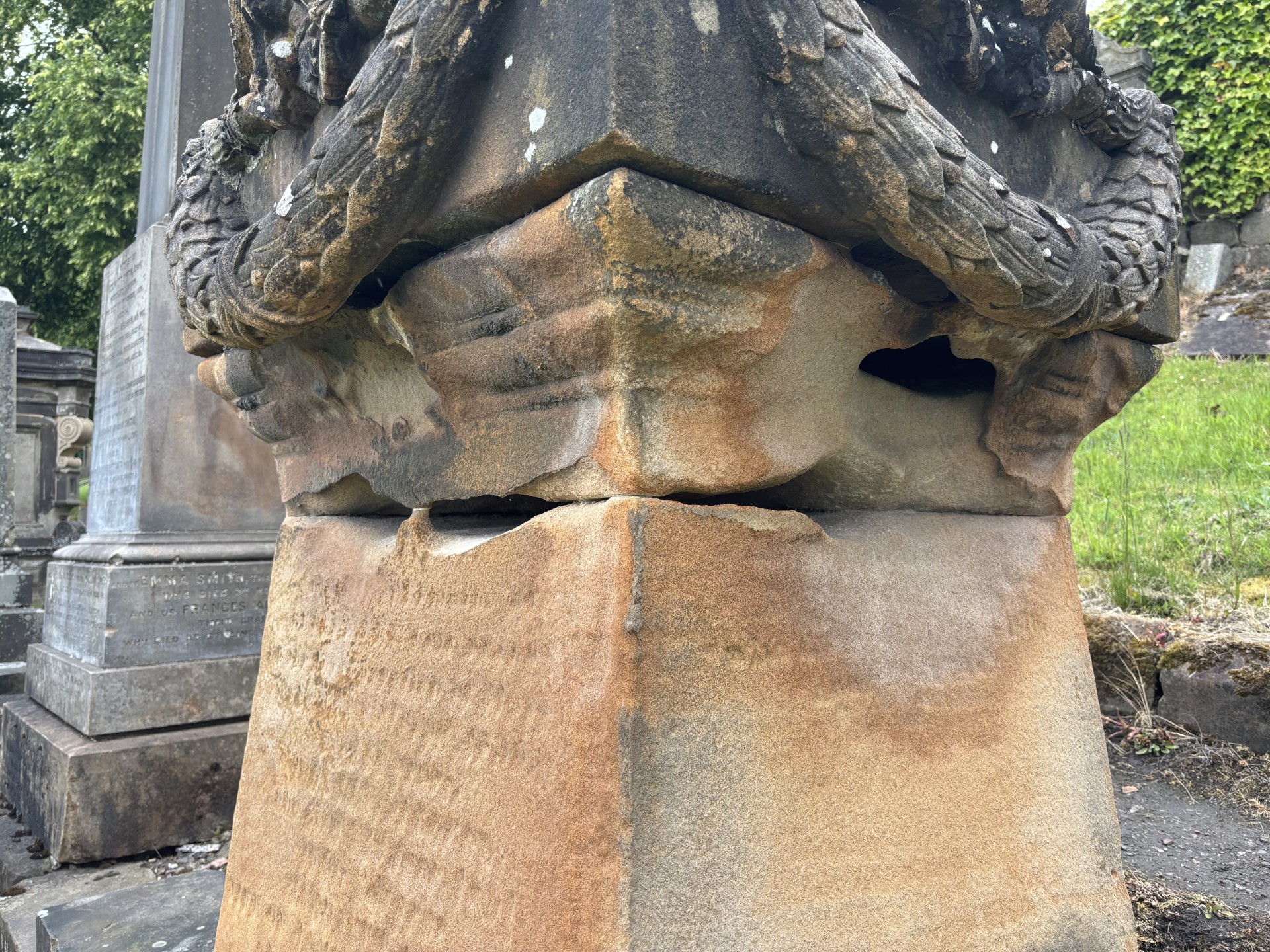
Sandstone memorial damaged by wetting and drying cycle.
The effects of storm damage on historic memorials
Storms present perhaps the most immediate and dramatic threat. In recent years, events such as Storm Éowyn in January 2025 and Storm Arwen in November 2021 have demonstrated how violent weather can damage historic sites. Storm Arwen damaged seven memorials within our care, including four at St Andrews Cathedral, a site which is very exposed.
As storms increase in both frequency and intensity due to climate change, cemeteries are facing escalating problems. While regular inspections can help to mitigate risk and maintain safety, they cannot always prevent sudden damage caused by extreme weather.
Strong winds topple trees
Wind brings the risk of falling branches or whole trees collapsing onto memorials, shattering or toppling them.
Heavy rainfall erodes soil
Rainfall compounds the problem, eroding soil around graves and undermining the bases of memorial stones. Where foundations have previously been exposed, the rate of deterioration will be even more rapid.
Saturated ground reduces stability
Graves tend to sink over time, and saturated ground reduces the stability of memorials even further, increasing the likelihood of leaning or collapse. As well as storm events, the wetter winter climate in general plays a significant role.
Salt causes flaking and surface loss
The risks are even greater for cemeteries in low-lying or coastal areas. Salt carried by storm surges or sea spray crystallises within the pores of stone, causing flaking and surface loss.
The effects of vegetation on memorials
Biological growth on gravestones is inevitable. Stone cleaning purely for aesthetic reasons is not encouraged, so it is important to know whether growth like lichen or algae is causing any damage or problems.
While certain lichens can act as a protective layer against pollutants, some can, on rare occasions, cause damage such as blistering or pitting. Algal growth is normally benign, unless the growth is heavy, but may be problematic – for example if causing paving stones to become slippery. Moss retains moisture against stone surfaces, encouraging biological weathering and salt crystallisation within the pores of the material.
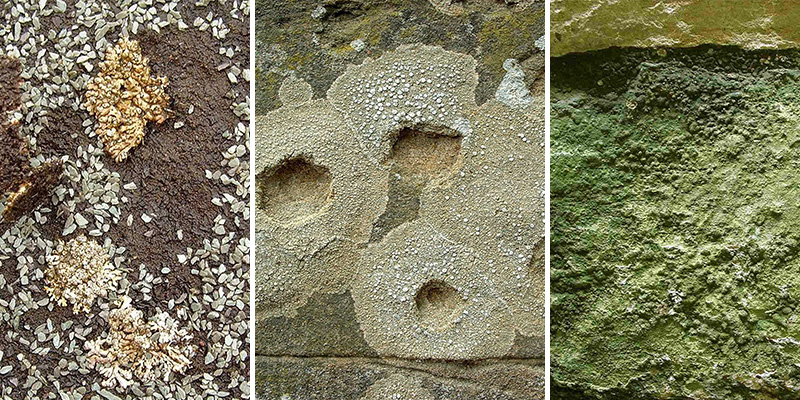
Examples of vegetation growth on stone – a and b: lichens; c: algal growth. © Scottish Lime Centre Trust.
Ivy and other climbing plants can penetrate joints and cracks, gradually forcing them apart. Beneath the ground surface, root systems can be equally destructive. Tree roots may dislodge or crack stones, while even small plants exert enough pressure to destabilise a memorial. These risks are heightened by environmental changes. Warmer, wetter conditions are extending the growing season, while milder winters reduce the natural dieback that once held plant spread in check. For cemeteries, this means more frequent vegetation management is required. Without it, irreversible damage can occur, compromising both public safety and heritage value.
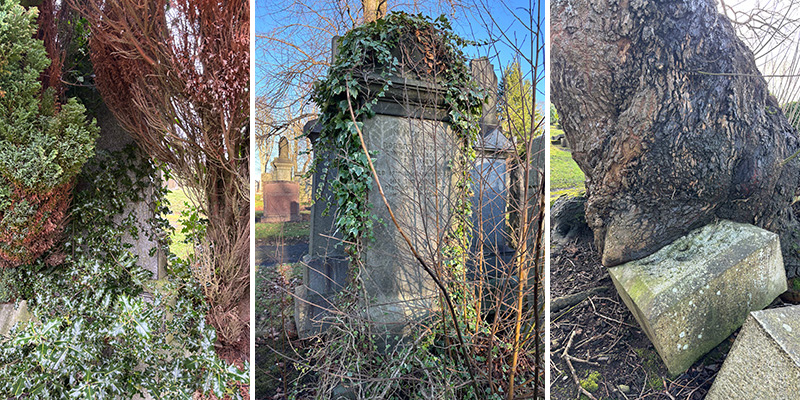
Examples of memorials surrounded by extensive vegetation growth.
Many historic memorials do not use dowels to secure their components – a construction method now required by the modern BS8415 standard. Instead, there is a reliance on the mortar bed to hold stone components together. When the mortar fails, a memorial is most likely to present a risk.
How do inspections manage risk and safety?
In the face of these risks, regular inspections are an essential management tool. They are required by law in Scotland and apply to all owners of cemeteries, including public bodies and private owners.
Inspections serve two purposes:
- to identify hazards to public safety
- to monitor the condition of memorials over time
A typical inspection begins with a visual assessment of structural stability. Is the stone upright? Do the joints appear sound? Does the memorial move when light pressure is applied? Other signs of deterioration are recorded including erosion, cracks, surface flaking, and biological growth. The inspection also considers environmental factors like proximity to trees, ground conditions and coastal exposure.
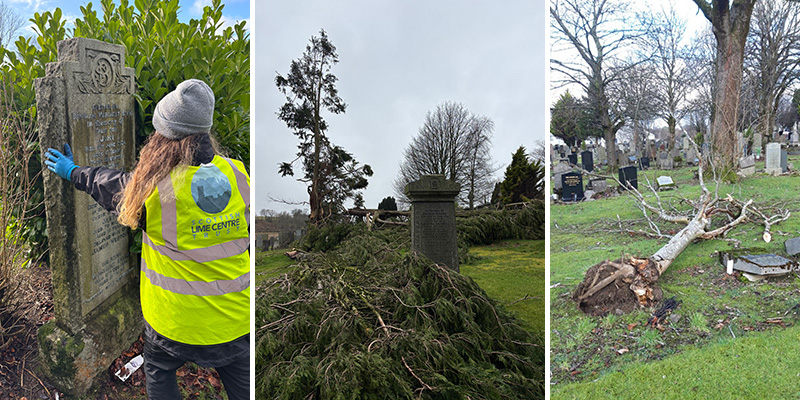
Carrying out a ‘hand test’. Centre and Right: Aftermath of Storm Éowyn, Paisley, January 2025.
The frequency of inspections depends on the safety condition of the memorial. If a memorial is completely secure then it does not need to be re-inspected for another five years. If it is not fully secure but does not present an immediate risk it needs more frequent monitoring, especially after storms. Parts of cemeteries which are used frequently, or suffer anti-social behaviour, may need closer monitoring and are always prioritised during inspection.
Find out more about our work inspecting and repairing gravestones.
How public awareness can help
If a memorial appears unstable, leaning, or otherwise unsafe, it should be reported to the burial authority that manages the cemetery. Prompt reporting allows professionals to assess the risk and take appropriate action if required, before accidents or irreversible damage occur.
The family (specifically the person who bought/holds the burial rights) should ensure that the relevant burial authority have their contact details should a repair ever be required to one of their memorials. It is always the family, not the burial authority, who is responsible for the memorial, even though the burial authority might have overall responsibility for the site. Incorrect methods of cleaning and repair can accelerate decline, so, if work is thought to be needed, contact should be made with the burial authority to seek advice, ensuring that any interventions adhere to regulations and best practice.
Ensuring memorials endure for centuries to come
Memorial stones and cemeteries play a vital role in our shared heritage. They connect us with individuals and communities of the past, while also serving as records of craft and cultural expression. Yet climate change is placing them under increasing strain. Storm damage, long-term weathering processes and vegetation growth all interact to accelerate deterioration.
Regular inspections and, where necessary, timely, appropriate interventions aim to eliminate any risk to public safety. In doing so, they also prolong the life and purpose of memorials, many of which could otherwise be lost or irreparably damaged within the coming century. By recognising the acceleration of climate change and adapting our conservation practices, we can work to ensure memorials are kept safe for the public, as well as protecting the memories they hold for centuries to come.
Discover biological growths that are commonly found on Scottish building and historic structures, and get advice on how to manage them in our Inform Guide: Biological Growth on Masonry.
About the author:
Emma Frost worked as our Memorial Inspection and Surveying Trainee hosted by Scottish Lime Centre Trust.
About the author:
Guest
From time to time we have guest posts from partners, visitors and friends of the Engine Shed.
View all posts by Guest
Comments are closed.

