

Key insights from studying Scotland’s standing stones
Behind the Scenes, Materials, Science | Written by: Samuel Matthews | Thursday 12 March 2026
Standing stones are some of Scotland’s most evocative historic places and many mysteries still surround them. At Historic Environment Scotland, we look after 33 standing stone sites across the country.
Roughly half of these monuments are prehistoric, including Orkney’s Stones of Stenness Circle and Henge or the Calanais Standing Stones, and they generally date from before the 1st century AD. The other half are medieval carved stones. The majority of these are Pictish and date broadly between AD 300-900; a striking example is Sueno’s Stone in Forres.
Our Heritage Science team have set out to add to our understanding of these important monuments. This blog looks at four of the 33 sites that have undergone a literature review and presents my findings for stones at Machrie Moor, Laggangairn, Aberlemno and Dogton.
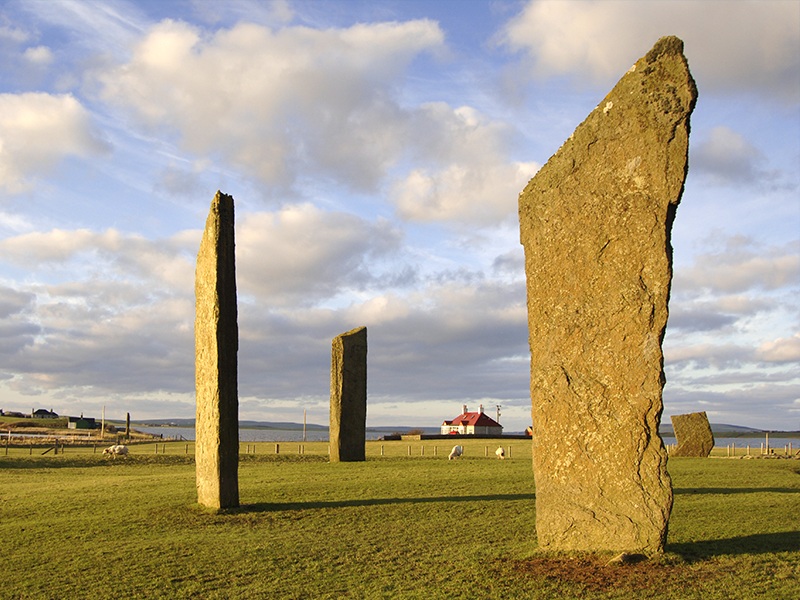
The Stones of Stenness Circle and Henge, Orkney.
Building on our Properties in Care (PiC) Stone Survey
Over the past few years, the Heritage Science team at the Engine Shed have been working on the PiC Stone Survey. This work looks at what types of stone make up the castles and cathedrals that we look after and where that stone comes from. At its core, the project is based on the idea that the more we know about how the buildings were constructed, the better we can care for them.
The focus of the survey was on buildings, but it was clear that there were opportunities to apply these methods elsewhere. To this end, we started a complimentary project, using similar methodology to look at two more types of sites: prehistoric standing stones and medieval carved stones.
All this work feeds into the development of the Building Stone Database for Scotland, created in collaboration with the British Geological Survey.
What are the key questions about the stones?
The Standing Stone Survey project aims to address a few key questions about these monuments.
- what stone are they made of?
- where has the stone come from?
- what condition are they in?
The answers to these questions will help us better understand the monuments in our care. For example, understanding how sites were constructed, how the stone material was selected and transported, can inform us about past societies. Understanding the condition of the stone is important for ensuring the monuments can be protected into the future.
To begin to answer these questions, I was asked to conduct a literature review of what has been written about these stones already. I consulted a range of sources, including our own Statements of Significance and the activities recorded on trove.scot. There were some fascinating discoveries and plenty of useful information to help us prepare for the survey of the stones themselves.
Machrie Moor Standing Stones
Machrie Moor is on the Isle of Arran and is home to several striking Neolithic stone circles that are part of a rich archaeological landscape. The circles on the moor use two distinctive types of stone and we have a good idea where that stone came from.
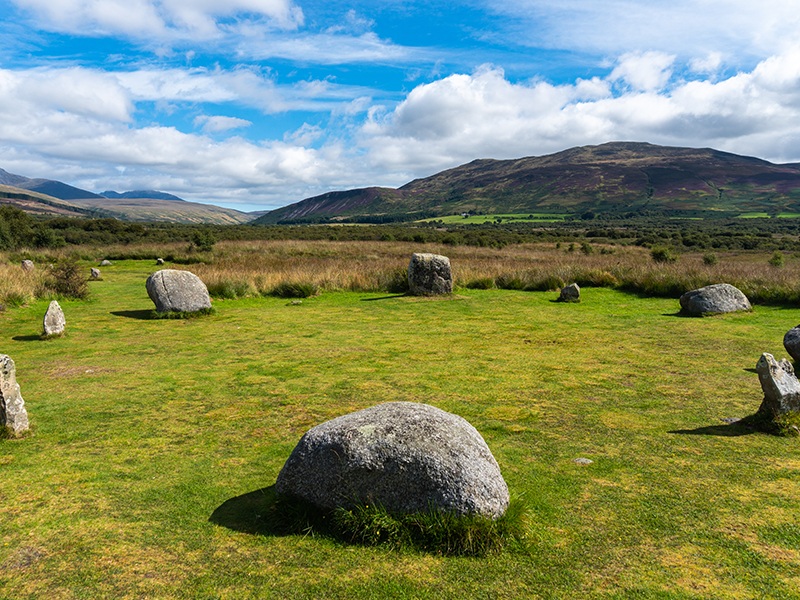
Machrie Moor Stone Circle 1, showing alternating sandstone slabs and granite boulders.
One of these stone types is sandstone, usually present in the circles in the form of slabs. The bedrock underneath Machrie Moor is sandstone, and outcrops of this rock can be seen along Machrie Water that runs just to the north of the stone circles, and by the coast. In their book, ‘Building the Great Stone Circles of the North’, Colin Richards and Joanna Wright identify a specific cliff about two miles away, below another nearby place we care for: the Auchagallon Cairn, as the likely source for the sandstones used in monuments in this area.
The other stone type used at Machrie Moor is granite, usually in the form of more rounded boulders. Granite can be found on Arran, but the form of these stones suggests a different origin; as glacial erratics. These are stones that are moved by glaciers and dropped in place when those glaciers melted, sometimes a long way from where they originally came from. In her report ‘Machrie Moor, Arran: recent excavations at two stone circles’, Alison Haggarty mentions seeing more of these glacially transported boulders dotted around the moor.
Machrie Moor is an example of a monument where we have a good understanding of the stones used. This was something of an exception amongst the sites reviewed – most are nowhere near as conclusive.
Laggangairn Standing Stones
The Laggangairn Stones, also known as Laggangarn, are a pair of prehistoric standing stones, with later medieval carvings. They can be found in Dumfries and Galloway, along the Southern Uplands Way. Antiquarian surveyors thought they were survivors of a larger group of stones. The Reverand George Wilson, writing for the Society of Antiquaries of Scotland in 1873, provides a particularly colourful story of the misfortune that befell a man who dared to use some of the stones in the construction of his own house:
“he was bitten by a mad dog, which he caught by the tail as it was going in at the dog-hole in the house-door, and brained it against the door cheek. He took hydrophobia, and, at his own request, was smothered under a feather-bed in a paroxysm of his disease! In the following autumn his sister-in-law, who had helped to smother him, slipped on some frozen straw in the barnyard, and suffered compound fracture of an arm, of which she died.”
As well as this warning to those who would disturb these monuments, Wilson relays stories of as many as fourteen stones existing at this site. Later surveyors were unable to find evidence for these additional stones.
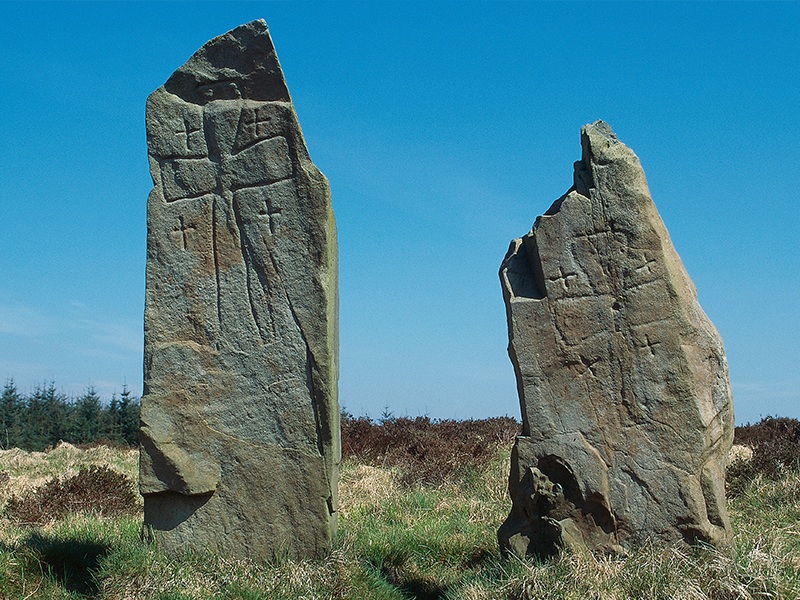
The Laggangairn Standing Stones.
More uncertainty arises from the material used for the standing stones. Several sources describe them as whinstone, which typically refers to hard, dark, volcanic rock. This is not found locally. However, whinstone is also used to describe the local Southern Uplands greywacke, which has similar properties despite being sedimentary in origin – so maybe the stones are made of that. Another source calls them sandstone. This kind of conflicting evidence will be addressed in a later stage of the project when we will visit the site and examine the stones ourselves.
Aberlemno Sculptured Stones
The other type of monument this survey studied were Pictish carved stones, generally created between 6-10th centuries AD. The village of Aberlemno hosts four of these stones, one of which fell in 2025 in a storm. This stone, known as Aberlemno III, is currently being cared for by our stone conservators. In the video below, Senior Stone Conservator Colin Muir talks about this ongoing work:
Update your personalised ad preferences to view content
The Aberlemno stones are all sandstone, which could have been sourced locally. They were created at different times, and it is not entirely clear if they are all in their original positions. Therefore, site survey to determine whether the monuments are of the same stone type could help answer questions about the relationship between them.
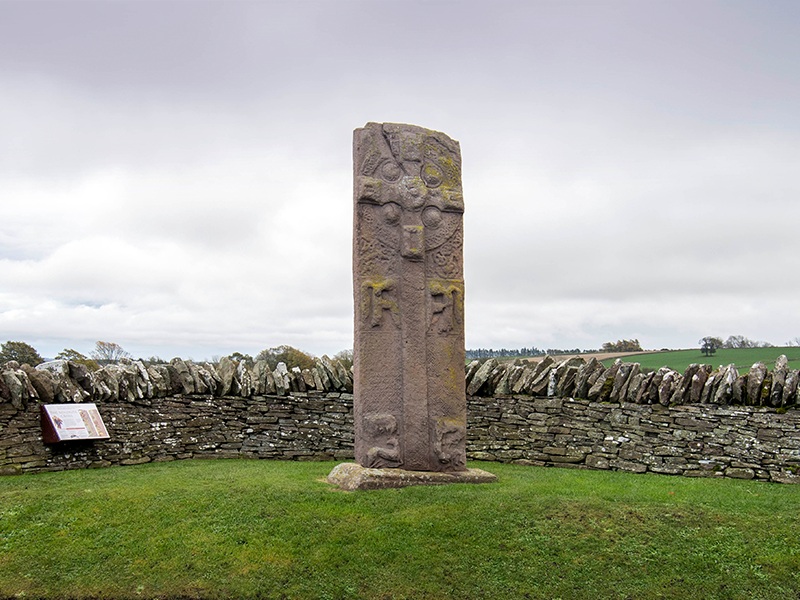
Aberlemno III in 2017 © Donald MacLeod
While the circumstances that Aberlemno III has come to us in have been sad to see, it is exciting to uncover new details of this very significant monument that are unrecorded.
We have unprecedented access to the interior of the stone, which is fresh and un-weathered. By examining this and comparing the fresh section to the exposed surface and other geological samples, we can get a better understanding of the stone type. This will help us understand and protect this and other monuments in our care.
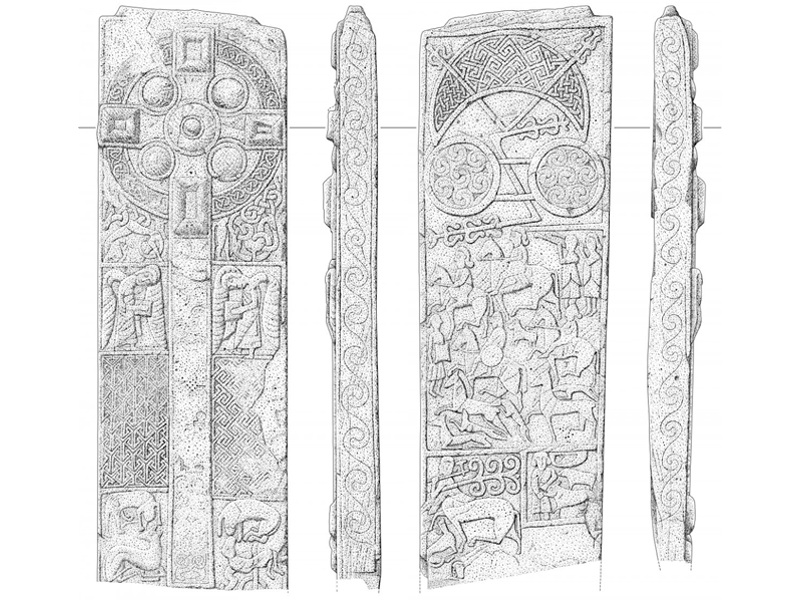
For the review, my focus was mostly on the material of the stone but there are other resources available, such as this drawing of Aberlemno III Pictish cross-slab.
The Dogton Stone
The purpose of the literature review is also to highlight any challenges we may face when going on site visits to the stones. The Dogton Stone, for example, is the remnant of a carved stone cross near Glenrothes in Fife, and it exhibits a number of these challenges.
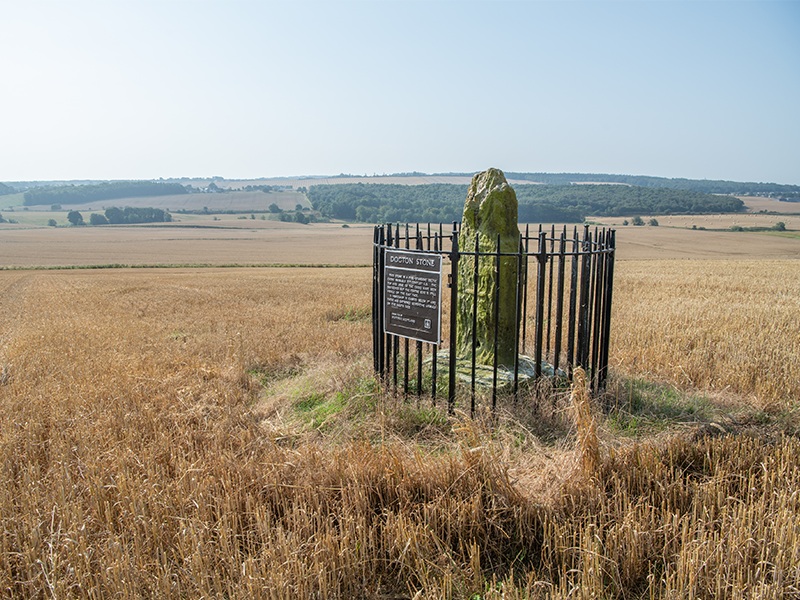
The Dogton Stone.
The stone likely sits in its original location, in the middle of farmland. Since there is no formal path to it, access could be difficult, especially at certain times of the year. This is an important consideration for our team as it makes it harder to bring along the scientific equipment we would hope to use for the survey phase.
Another consideration for its location is that fertiliser use in the surrounding field encourages biological growth on the stone, largely in the form of algae or mosses. Whilst these aren’t necessarily damaging to the stone, they do impact our ability to examine it, by obscuring the surface.
By highlighting these difficulties, the literature review allows us to better prepare for site visits. This lets us use our time on site efficiently.
Next steps for the project
All our 33 standing stone sites have now been subject to a literature review. The next stage of the project is the site visits, which we are hoping to pilot in the near future. We’ll share more updates as the work develops.
In the meantime, you can explore several 3D models on Sketchfab, created by the Digital Innovation and Documentation team, based at the Engine Shed. These have been created for several standing stones in our care.
About the author:
Samuel Matthews
Sam is an Archaeological Science Fellow, working in the Heritage Science Team at the Engine Shed. During his fellowship he has used a wide range of scientific techniques to analyse and understand archaeological objects.
View all posts by Samuel Matthews